
META ADS / EVENT SERVICES
RON 9.21 a day.Services worth
thousands of euros.
A limited budget. A high-value service. A clear path from video to enquiry.
Explore the resultsHow the figures are calculated
Average cost = RON 267.09 / 4 forms, rounded to two decimals. Daily average = RON 267.09 / 29 calendar days. Spend varied between days; this average is not a fixed daily budget. Media spend only; management is separate. Technical tests and enquiries from other sources are excluded.
META ADS · 15.10.2026
Evidence from the platform.
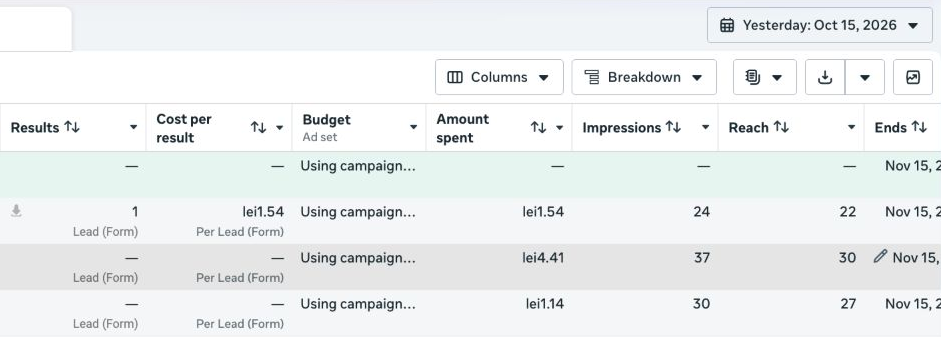
An actual Meta Ads screenshot for 15 October. Account, ad names and client thumbnails are cropped out; the figures are unchanged.
Context
The service is quoted individually, with proposals in the project reaching several thousand euros. A useful enquiry needs event details, and the provider must check availability before confirming a proposal.
Video footage shows the real performance and atmosphere. Requesting a quote is the next step for an interested viewer; watching a video alone is not treated as a commercial outcome.
Concrete problem
Views and engagement do not show who is organising an event or what can be quoted. The campaign aimed to generate enquiries containing enough context to continue a commercial conversation.
Enquiries also needed to be kept together, with a status and a next step, so a received form could be distinguished from a sent proposal and a booking.
What changed concretely
- Video ads using the provider’s real footage, directing viewers to request a quote.
- An instant form asking for event type, location, date and contact details. The date is optional.
- Intake into a central registry, with enquiries shown in an application and tracked through statuses and follow-ups.
- New-enquiry notifications and a record of the subsequent conversations.
The questions provide initial context for quoting. The documented form does not verify available budget or acceptance of the price; those points are clarified in the commercial conversation.
The implemented journey
Each enquiry has a next step.
-
01
Real footage
The person sees the service in the context of an event.
-
02
Contextual form
They specify the event type, location and date, if known.
-
03
Application intake
The enquiry enters the registry and can be tracked.
-
04
Quote and follow-up
The provider checks availability and records the outcome.
An explanatory process diagram, not a measured conversion funnel.
Results within a defined period
The pilot ended on 14 October. The following day belongs to the continuation and is shown separately, so a one-day result is not mistaken for the performance of the pilot.
| Period | Spend | Forms | Cost / form |
|---|---|---|---|
| Pilot · 17 Sep–14 Oct | RON 260.00 | 3 | RON 86.67 |
| Continuation · 15 Oct | RON 7.09 | 1 | RON 7.09 |
| Total · through 15 Oct | RON 267.09 | 4 | RON 66.77 |
The figures come from the campaign review. The forms were matched to real enquiries in the registry. One form in the new phase does not establish a stable cost or prove that a creative change caused a better outcome.
What we delivered
Meta campaign setup and management, ads using supplied footage, a contextual form and an application intake workflow. Enquiries, proposals and follow-ups share a common record.
The application and notifications were developed during the project. The figures are totals for the period, not an experiment isolating the impact of each intervention.
What the result demonstrates
At an average spend of RON 9.21 a day, the campaign generated four identifiable enquiries. The assessment places enquiry volume alongside total investment and the RON 66.77 cost per form. The workflow supports continuing the conversation using event details and recording the outcome. A higher budget does not guarantee the same cost per form or proportional growth.
No contracts or deposits were recorded at the 16 October check. Proposals worth several thousand euros are quoted amounts, not generated revenue. This case does not establish profitability, a closing rate or guaranteed performance.
An anonymised case study. The provider’s identity, contact details, account identifiers and individual enquiry information are omitted. Only aggregate statistics and an explanatory diagram are shown, without conversation or customer-registry screenshots.